
September is the month the light changes in Washington, and it is also the month clients start asking about blue stones. Sapphire is September’s birthstone, and the gem traditionally given at the fifth and forty-fifth anniversaries. Anyone shopping for sapphire jewelry in DC this fall will find that two stones of identical weight can differ in price by a factor of twenty, and that the reasons are knowable. Good sapphire rewards that curiosity. It is one of the few colored stones durable enough for daily wear and deep enough in history to collect seriously. Clients who spent the summer looking at diamonds often return in the fall asking about color instead. What follows is the same conversation we have across the counter at the Willard and in Chevy Chase, written out. Charles Schwartz & Son has been selling and servicing fine colored stones in Washington since 1888. Much of the sapphire that passes through our hands is not new. It arrives set in Edwardian platinum or Art Deco geometry, and it lives in our vintage jewelry collection.
What a Sapphire Actually Is
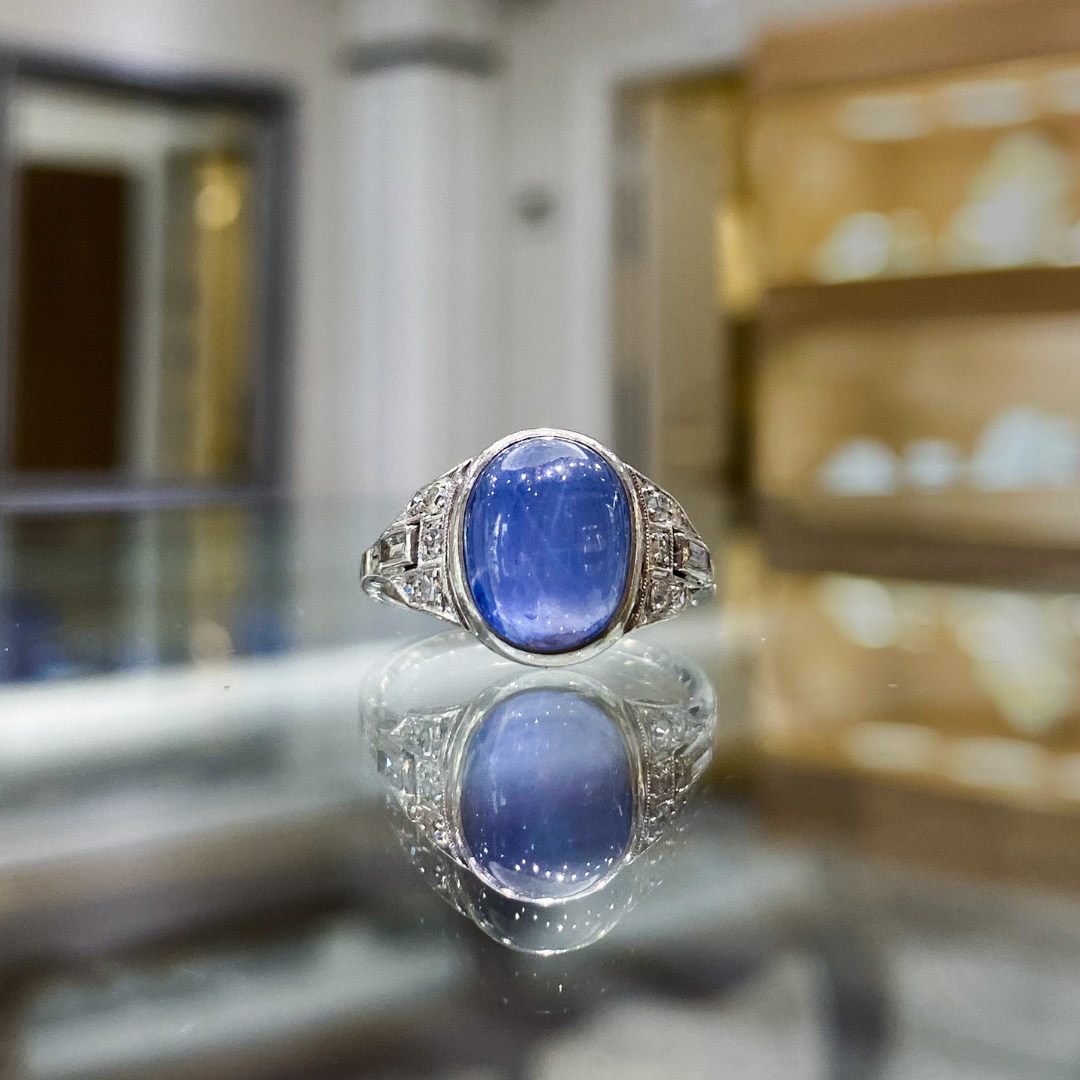
Sapphire is a variety of the mineral species corundum, crystalline aluminum oxide. Its close relative is ruby. The distinction is purely one of color: red corundum is ruby, and, as GIA puts it, sapphires come in every color except red.
The numbers matter for anyone buying a stone to wear. Sapphire sits at 9 on the Mohs scale of scratch resistance, with a refractive index of 1.762 to 1.770 and a specific gravity of 4.00, according to GIA’s Gem Encyclopedia. GIA also notes that corundum has excellent toughness and no cleavage, which is the more practical fact. Hardness describes resistance to scratching. Toughness describes resistance to breaking. Sapphire is unusual in having both, and that combination is why it holds up in a ring worn every day for fifty years.
Color comes from trace elements caught in the crystal lattice. GIA explains that when the trace elements are iron and titanium, the corundum is blue sapphire, while chromium produces the red of ruby or the pink of pink sapphire. The same page notes that some sapphires change color, shifting from blue in daylight or fluorescent light to purple under incandescent light.
The rarest color has its own name. A mix of pink and orange is known in the trade as padparadscha, which GIA calls an extremely rare and collectible variety, named for the lotus flower. Be careful with the term. GIA acknowledges openly that the definition of padparadscha has always been debated, and applies it on a report only when a stone meets its criteria. No numeric color range is published. Anyone quoting one is quoting themselves.
How to Judge a Sapphire
Color carries the most weight. GIA states plainly that color has the greatest influence on a sapphire’s value, and that the most valued blue sapphires are velvety blue to violetish blue in medium to medium-dark tones. A stone that is too light reads gray in the shade. A stone that is too dark closes up under restaurant lighting, which is where a great deal of jewelry is actually seen.
Clarity expectations differ from diamond. GIA notes that blue sapphires typically have some inclusions but generally show better clarity than rubies. A completely clean sapphire is not the goal, and in fine unheated material a light veil of silk is often what produces the velvety quality collectors pay for.
| Quality factor | What to look for | What quietly costs money |
|---|---|---|
|
|
|
|
|
|
|
|
|
|
|
|
|
|
|
Cut deserves more attention than it gets. Sapphire is strongly pleochroic, meaning it shows different colors along different crystal directions, so the cutter’s orientation decision determines whether the finished stone faces up blue or violet. Rough is also expensive, which tempts cutters to leave weight in the pavilion. A 3-carat sapphire cut for weight can look smaller than a well-proportioned 2.50.
Heat, Diffusion, and What Must Be Disclosed
Heating sapphire is old, common, and legitimate. GIA describes heating as an accepted treatment for sapphire and notes that confirmation from an independent laboratory that there is no evidence of heat adds to a stone’s rarity and value. Heat can intensify or even induce blue coloration and remove silk inclusions.
Lattice diffusion is a different matter and needs to be understood before you buy. GIA explains that diffusion uses heat and chemicals to diffuse an element into a gemstone to artificially change its color, and that in some cases the added color is shallow while in others it penetrates the whole stone. Beryllium diffusion in particular can change the color of even large sapphires throughout.
None of this is a problem when it is disclosed. It is a serious problem when it is not. The FTC Jewelry Guides, codified at 16 CFR Part 23, make it unfair or deceptive to fail to disclose a treatment that is not permanent, creates special care requirements, or has a significant effect on the stone’s value. Ask for the disclosure in writing. A jeweler who cannot produce it is telling you something.
The same rule governs laboratory-grown material. Under 16 CFR Part 23, the word sapphire may not be used for a lab-grown stone unless it is immediately preceded with equal conspicuousness by “laboratory-grown,” “laboratory-created,” a manufacturer-created designation, or “imitation” or “simulated.” GIA defines a synthetic gem material as one made in a laboratory that shares virtually all chemical, optical, and physical characteristics of its natural counterpart, and notes that flame-fusion material grown by the Verneuil method can be produced in a matter of hours while flux-grown crystals take months or a year. Under magnification, flame-fusion sapphire typically shows very distinct curved growth striations and strain.
Star Sapphires and the Silk That Makes Them
Asterism is the star effect seen in a domed cabochon. GIA describes it as reflections from tiny, needle-like inclusions, and notes that the best and most expensive star corundum is semi-transparent, with just enough silk to create a well-defined star.
The Smithsonian gives the mechanism precisely. The needles are crystals of the mineral rutile aligned in three directions inside the sapphire, intersecting at 120 degrees to form the six-rayed star. Too little silk and the star is faint. Too much and the stone goes cloudy and gray. The balance is narrow, which is why fine star sapphires remain genuinely uncommon and why so much of what circulates is synthetic.
Sapphire in Period Jewelry
Washington collectors encounter sapphire most often in two settings: Edwardian platinum and Art Deco geometry. Both are represented in our vintage rings and vintage necklaces.
The Smithsonian’s National Gem Collection, a short walk from our Willard location on F Street, holds the reference examples. The Logan Sapphire is a 423-carat Sri Lankan cushion mixed cut, framed by twenty round brilliant diamonds totaling roughly 16 carats and described by the museum as the heaviest mounted gem in the collection. A 1997 GIA report found no evidence of heat treatment. The Bismarck Sapphire Necklace carries a 98.57-carat Burmese sapphire mounted by Cartier in platinum with 312 baguette and round brilliant diamonds. The Star of Asia is a Burmese star sapphire cut as a round cabochon, and one of the best-known star stones in any public collection. Note that the museum’s own record for it carries an internal inconsistency in its stated weight, which is a useful reminder that even excellent institutions have data errors. An Edwardian platinum necklace by Marcus & Co., set with a 60-carat Sri Lankan star sapphire and 126 diamonds, entered the collection in 1981.
Art Deco brought sapphire into sharper company. GIA dates the Art Deco period from the 1920s through the 1930s and notes that its jewelers used platinum and white gold, geometric shapes, and vivid color contrasts, citing a platinum, sapphire, and diamond pendant brooch as an example. Where Art Nouveau favored organic curvilinear flourishes, Art Deco embraced the vertical line and repetitive geometry, supported by baguette, triangle, trapeze, and half-moon diamond cuts. We have written more about that period in our guide to Art Deco engagement rings, and about buying period pieces generally in our complete guide to estate jewelry in DC.
Sapphire also turns up in Edwardian and Belle Époque work, usually as calibrated accent stones set into platinum filigree with millegrain edges. Those pieces are frequently the best value on the case, because their scale is modest and the condition is often original. Look for them among vintage earrings and vintage brooches.
The Sapphire Engagement Ring
Sapphire as an engagement stone is not a recent idea, but one moment made it permanent. GIA records that the association was reinforced in 1981, when Britain’s Prince Charles gave a blue sapphire engagement ring to Lady Diana Spencer, and describes the stone as a 12-carat blue sapphire surrounded by diamonds. We cite GIA on that figure deliberately. A great many other specifications circulate about the ring that no authority publishes.
The practical case for a sapphire engagement ring is durability plus distinction. At Mohs 9 with excellent toughness, it is one of the few colored stones a jeweler will recommend without hedging for daily wear. It also allows a larger, more architectural stone at a given budget than a diamond of comparable presence. Couples in Georgetown, Bethesda, and Northern Virginia increasingly pair a sapphire center with diamond accents, and our vintage engagement rings and engagement ring collection in DC both include period and contemporary examples.
Caring for Sapphire Through a Washington Autumn
Sapphire is forgiving, within limits. GIA’s guidance is that warm, soapy water is always safe, and that ultrasonic and steam cleaners are usually safe for untreated, heat-treated, and lattice-diffusion-treated stones.
The exceptions are firm. Fracture-filled, cavity-filled, or dyed material should be cleaned only with a damp cloth, and such stones can be damaged by even mild acids like lemon juice. Fracture-filled sapphires contain high-lead-content glass. Lattice-diffused stones can lose color if the surface is damaged, which is a real risk during repolishing. This is exactly why disclosure matters before the piece ever reaches a bench.
Fall is also when heavier knits, coat sleeves, and scarves start catching on prongs. Rings that were fine all summer come back in October with a stone that rattles. A quick check before the holiday season is cheap insurance, and our workshop handles that as part of routine jewelry repair and restoration.
Buying Sapphire Jewelry in Washington DC
A short list of questions separates a good purchase from a regret:
- Has the stone been treated, and how? Get the answer in writing.
- Is there an independent laboratory report, and does it address origin and heat?
- What is the tone in low light? Ask to see the piece away from the display spots.
- Is the mounting original to the stone, or has it been reset? Both are acceptable, but they price differently.
- Who services the piece after the sale?
That last question is the one most buyers skip. A sapphire bought from a jeweler with a bench in the building gets checked, tightened, and cleaned for the rest of its life by people who know the piece. That is a large part of what more than a century in Washington actually buys a client. If you are curious about how we evaluate pieces, our jewelry education pages cover the fundamentals, and clients considering a sale can start with selling precious gemstones.
See September’s Stone in Person
Our showrooms hold sapphires across the range, from Edwardian accent work to important single stones, alongside our designer jewelry collection.
Searching for Vintage Designer Jewelry in DC? Visit us in the Barlow Building at 5454 Wisconsin Avenue in Chevy Chase, or at The Willard Hotel at 1400 F Street NW in Washington DC. Find hours and directions for both locations, or contact us to arrange a private appointment or an evaluation of a piece you already own.
Key Takeaways
- Sapphire is corundum, Mohs 9, with excellent toughness and no cleavage, which is why it holds up to daily wear better than most colored stones.
- Color drives value more than any other factor. GIA identifies velvety blue to violetish blue in medium to medium-dark tones as the most valued range.
- Origin materially affects price. GIA states a fine Kashmir sapphire can sell for many times more than an exceptional Madagascar stone of the same quality and size.
- Heat treatment is accepted and common. Lattice diffusion is different, and both must be disclosed under the FTC Jewelry Guides at 16 CFR Part 23.
- Star sapphires owe their asterism to aligned rutile needles intersecting at 120 degrees, per the Smithsonian.
- Warm soapy water is always safe. Ultrasonic and steam are not safe for fracture-filled, cavity-filled, or dyed stones.
Frequently Asked Questions
Is an unheated sapphire worth the premium?
It depends on what you are buying for. GIA notes that laboratory confirmation of no heat adds to a sapphire’s rarity and value, so for a collector or an important stone the premium is defensible. For a wearable piece under a few carats, a well-cut, well-colored heated sapphire usually delivers more visible quality per dollar.
What is the difference between a sapphire and a blue spinel or blue topaz?
They are unrelated minerals. Sapphire is corundum at Mohs 9. Spinel is magnesium aluminum oxide, and topaz is an aluminum silicate. All three can look blue, but they differ in refractive index, specific gravity, and durability, which a gemologist confirms with standard testing rather than by eye.
Can a sapphire be resized or reset without damaging it?
Usually yes, with one important caveat. Untreated and heat-treated sapphire tolerates bench heat well. Lattice-diffused and fracture-filled stones do not, and can lose color or filling during repair. Always tell the bench what the treatment disclosure said, and when in doubt the stone comes out of the mounting first.
Where can I see important sapphires in Washington DC?
The Smithsonian’s National Museum of Natural History displays the Logan Sapphire, the Bismarck Sapphire Necklace, and the Star of Asia in the National Gem Collection, roughly a ten-minute walk from our Willard Hotel showroom on F Street NW.
Does a sapphire need its own insurance appraisal?
If the piece is significant, yes. An appraisal documents the stone’s characteristics and disclosed treatments at a specific date, which is what an insurer needs to replace it accurately. Contact us and we can arrange an evaluation.
Are lab-grown sapphires real sapphires?
Chemically and optically, yes. GIA defines a synthetic gem as one made in a laboratory sharing virtually all the properties of its natural counterpart. Legally, the distinction still must be disclosed: 16 CFR Part 23 requires the word sapphire to be immediately preceded with equal conspicuousness by a term such as laboratory-grown or laboratory-created.
Glossary
Art Deco: The design period GIA dates from the 1920s through the 1930s, marked by geometry, platinum, and strong color contrast.
Art Nouveau: The preceding movement, defined by organic, curvilinear forms rather than geometric ones.
Asterism: The star effect in a cabochon, produced by light reflecting from aligned needle-like inclusions.
Belle Époque: The turn-of-the-century European period whose light, lacy platinum work overlaps the Edwardian style.
Cabochon: A domed, unfaceted cut. Star sapphires must be cut this way for the star to appear.
Carat: The unit of gem weight, equal to 0.2 grams.
Corundum: Crystalline aluminum oxide, the mineral species that includes both sapphire and ruby.
Edwardian: The early twentieth-century period known in jewelry for pierced platinum, filigree, and fine millegrain edges.
Engagement ring: A ring given at betrothal. Sapphire centers have been a recognized alternative to diamond for well over a century.
Facet: One of the flat polished planes on a cut gemstone.
Filigree: Delicate openwork formed from fine metal wire, characteristic of Edwardian mountings.
Gemology: The science of identifying, grading, and evaluating gem materials.
Millegrain: The row of tiny beads worked along a metal edge with a knurling wheel, common on period platinum.
Mohs scale: The comparative scale of scratch resistance. Sapphire is 9. It measures scratching only, not toughness or heat tolerance.
Padparadscha: The trade name for a rare pink-orange sapphire, named for the lotus flower. GIA notes the definition is debated and applies the term only when a stone meets its criteria.
Pleochroism: The property of showing different colors along different crystal directions, which is why cutting orientation changes how a sapphire faces up.
Provenance: The documented history of ownership of a piece, which can add materially to value.
Rutile: Titanium dioxide. Its needle-like crystals inside corundum are the silk that produces asterism.
Sapphire: Any gem-quality corundum other than red. September’s birthstone.
Ultrasonic cleaning: Cleaning by high-frequency vibration in a liquid bath. Safe for many sapphires, unsafe for fracture-filled, cavity-filled, or dyed stones.
Verneuil method: The flame-fusion process used to grow synthetic corundum, which can produce a crystal in hours.


