
Every September the workshop gets busy. Sleeves get longer, knits get looser, and prongs that spent August untouched start catching on wool. Then comes the season of parties, weddings, and proposals, when pieces that live in a safe for most of the year come out to be worn. Booking jewelry repair in DC in early fall is the difference between a quick tightening now and a lost stone in December.
Charles Schwartz & Son has kept a bench in Washington since 1888. A jeweler with a workshop in the building can look at a ring, tell you what is happening to it, and hand it back the same week. This guide covers what we look for and what the work involves.
Why Fall Is the Season for DC Jewelry Repair
Three things converge in September and October.
- The first is wear. Jewelers Mutual recommends professional inspections and cleanings twice a year, and suggests that frequently worn high-end pieces may warrant a look every three to four months. GIA’s guidance is that jewelry should be checked every six months. Fall is the natural checkpoint.
- The second is calendar pressure. Bench work is not instant. A shank replacement, a full restoration, or a watch overhaul takes time, and bench schedules fill up as December approaches. Book now, not in November.
- The third is insurance. Jewelers Mutual recommends an updated appraisal every two years. The American Gem Society goes further, warning that without yearly inspections and re-evaluations you run the risk of being underinsured. Values move. Coverage written five years ago rarely replaces a piece today.
What a Professional Jewelry Inspection in DC Actually Checks
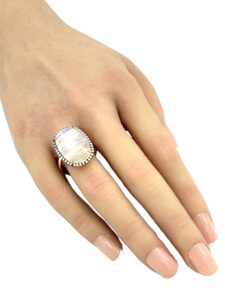
An inspection is not a polish. Under magnification, a bench jeweler is looking for a specific list of failures. Jewelers Mutual names them: loose, cracked, or chipped stones; bent, broken, or worn-out prongs; weakened or broken clasps; uneven wear patterns; loose or cracked settings and mountings; and scratches, cracks, chips, or stressed spots in the metal, including a thinning or cracked ring shank.
There are two checks you can do at home between visits. Jewelers Mutual suggests holding the piece to your ear and shaking it gently: can you hear a rattling noise? Jewelers of America suggests a second method, checking for loose gemstones by touching them with a toothpick. Either result means the piece should not be worn until it has been seen.
Jewelers Mutual also lists the visual warning signs that a failure is close: a prong that appears slightly shorter than the others, or whose rounded top seems to have narrowed; a center stone no longer sitting level; clasps that do not close tightly; stretched necklace or bracelet strands, which the company flags as especially dangerous in the case of pearls. Their conclusion is the one we would give: the sooner you catch a problem, the easier and cheaper it is to fix.
Prongs, Retipping, and Reshanking: Jewelry Repairs in Washington DC
Prongs are the most common repair on any bench. Jewelers of America explains that constant wear of rings can cause prongs to wear and increase the chance of losing a stone, and that prongs are either replaced outright, retipped by adding metal to the tip, or replaced as an entire head.
Shanks wear from the opposite direction. Skin, soap, and desk edges thin the bottom of a ring until it flexes. Jewelers Mutual describes a half shank replacement, replacing a portion of the shank with a new, thicker band, with a full shank replacement required if the ring is severely damaged. Catching a thin shank before it cracks is the cheaper path, because a cracked shank often distorts the head as well.
Resizing has more than one method, and the right one depends on the ring.
| Repair | What happens at the bench | Best suited to |
| Prong retipping | Metal is added to the worn tip and reshaped | Rings worn daily where tips have flattened or narrowed |
| Head replacement | The entire setting head is removed and a new one fitted | Heads worn past the point where retipping holds |
| Half shank | The worn lower portion is cut out and a new, thicker section fitted | Shanks thinned by years of wear but otherwise sound |
| Full shank | The whole band is replaced and the original head reset | Severely damaged or repeatedly repaired rings |
| Cutting and soldering | The band is cut and metal added or removed, then finished | Most standard resizes, up and down |
| Sizing beads | Small beads are added inside the shank | Half-size adjustments and rings that spin |
| Spring insert | A sprung insert is fitted inside the band | Arthritic knuckles; adjusts one to two full finger sizes |
Jewelers of America names two marks of a good repair: no visible seams from cutting and soldering, and stones that are tight and secure in their settings. The organization also runs a three-level bench jeweler certification, from Certified Beginner Bench Jeweler through Certified Master Bench Jeweler, with written and practical examinations set to national standards. It is a reasonable thing to ask about.
White Gold, Rhodium, and Platinum
Two metals, two entirely different maintenance stories.
Jewelers of America explains that pure gold is very yellow, and no matter how much you alloy it with white metals it will almost always retain some yellowish body color. Most white gold is therefore flash plated with a very thin coating of rhodium, a bright white platinum-group metal that does not oxidize. That plating wears off and reveals the gold underneath. GIA confirms that rhodium plating wears away gradually over time, requiring the ring to be replated occasionally. How often depends on wear.
Platinum behaves differently. Jewelry marked only “Platinum,” “Pt,” or “Plat” contains at least 95 percent pure platinum per Jewelers of America, and a 90 percent platinum piece weighs about 60 percent more than a 14-karat gold piece of similar size. Platinum develops a natural patina that can be returned to a bright white shine with simple repolishing, and the metal sustains very little metal loss over a lifetime of wear. GIA adds that platinum prongs, being less brittle than gold alloy, are less likely to break. That is why Edwardian and Art Deco mountings so often survive a century intact.
One care instruction applies to both. Jewelers of America is blunt: keep fine jewelry away from chlorine and salt water, and remove all jewelry before going into a hot tub, swimming pool, or salt water. Jewelers Mutual adds that bleach, ammonia, and chlorine can damage white gold’s rhodium plating.
Pearls, Silk, and Restringing
GIA’s guidance is straightforward: pearls worn often should be restrung once a year. The reason is mechanical. A strand stretches, knots loosen, and the failure is total rather than partial.
Pearl care is also unusually strict, because nacre is soft and chemically vulnerable. GIA notes that pearl sits at 2.5 on the Mohs scale, very soft and easily scratched or abraded, and can be damaged by many chemicals and all acids, including hair spray, perfume, cosmetics, and perspiration. Pearls should never be cleaned in an ultrasonic or steam cleaner. Wipe them with a soft cloth after each wearing, use warm soapy water only for occasional thorough cleaning, and make certain the string is completely dry before wearing. The old rule still holds: pearls on last, off first.
Washington DC Watch Repair and Water Resistance
Service intervals depend on the maker.
Rolex publishes a detailed account of its servicing procedure: the movement is entirely dismantled and all the parts carefully examined, parts that no longer meet Rolex requirements are systematically replaced, components are cleaned, dried, reassembled, and lubricated, case and bracelet are refinished, seals are replaced, and the watch is pressure-tested in water. Precision testing includes a Rolex-specific test lasting at least 24 hours, and the work carries a two-year service guarantee.
Omega recommends a complete service every 5 to 8 years and a water resistance check once a year. TAG Heuer states that its watches should be overhauled approximately every five to six years, or as soon as there is a sign of malfunction, and that watches worn in water should be tested for water resistance every two years.
The reason is the gasket. Omega explains that water resistance is ensured by gaskets placed between the crown, pushers, crystal, and case, and that these deteriorate over time under the influence of temperature variations, pollution, or chemicals and must be replaced regularly. A watch that was water resistant when purchased is not water resistant forever, and a pressure test is the only way to know.
For quartz pieces, the simplest service matters more than it sounds. A dead battery left in a case can leak. We handle watch battery replacement while you wait.
Restoring Antique Jewelry: Conserve, Repair, or Convert
The hardest question in antique work is not technical. It is whether to preserve a piece or change it.
GIA’s advice is the right starting point. If you do not know the historical or monetary value of an heirloom, take it to a jeweler or appraiser before altering it in any way. Some heirlooms, GIA writes, are like a faded painting by a grand master, a precious object to be restored to its original condition. Others are better reinvented, because jewelry is meant to be worn and a piece that reflects your taste is a piece you will actually wear. GIA also recommends that if stones are removed, they be documented with independent grading reports covering their properties and treatments, since that information is what an appraiser needs to determine value.
A few bench principles we hold to on period work:
- Original material is not replaced when it can be stabilized.
- Hallmarks and maker’s marks are protected during polishing. A mark polished away is provenance destroyed.
- Replacement parts are made to match the period, not the current catalog.
- Anything removed is returned to the client, documented.
FTC consumer guidance explains that the karat mark tells you how much pure gold the piece contains, that near the karat mark you should look for the registered trademark of the company standing behind it, and that sterling silver describes products containing 92.5 percent pure silver, often marked 925.
Clients weighing restoration against sale can read our guide to estate jewelry in DC or start with selling antique jewelry.
DC Jewelry Appraisals and Documentation
An appraisal is a dated professional opinion, and it ages. The National Association of Jewelry Appraisers states that appraisers should be highly qualified professional appraisers with expertise specific to the assignment. Its members follow a code of ethics and a client’s bill of rights.
Update the document when the piece is altered, when a stone is replaced, and on the schedule your insurer expects. If you would like a piece evaluated, contact us and we will arrange it.
Book Your Fall Service Before the Season Fills
Bring in the pieces you plan to wear this autumn and winter, and the ones you have been meaning to look at for years.
Our workshop handles inspection, DC Jewelry repair, resizing, restringing, and watch service, and more. Hours and directions for both showrooms are on our site.
Key Takeaways
- Jewelers Mutual recommends professional inspection and cleaning twice a year, and more often for frequently worn high-end pieces.
- Two home checks catch most problems early: listen for a rattle, and test stones gently with a toothpick.
- Prong retipping and half shank replacement are routine. Waiting until a shank cracks turns a small job into a large one.
- White gold needs periodic rhodium replating. Platinum needs only repolishing and sustains very little metal loss over a lifetime.
- Pearls worn often should be restrung once a year, per GIA, and never cleaned ultrasonically.
- Omega recommends a complete service every 5 to 8 years with an annual water resistance check; TAG Heuer recommends overhaul every five to six years.
- On antique pieces, protect hallmarks during polishing and document anything removed.
Glossary
Assay office: An independent institution that tests precious metal and applies hallmarks.
Estate jewelry: Any previously owned jewelry, regardless of age. Not all estate jewelry is antique.
Fineness: The proportion of precious metal in an alloy, expressed in parts per thousand. Sterling silver is 925.
Gasket: The compressible seal at a watch’s crown, pushers, crystal, and case back. Gaskets degrade with time and chemicals, which is why water resistance must be retested.
Hallmark: An official mark applied after independent testing that guarantees a metal’s fineness, plus the marks identifying the assay office and the sponsor.
Mohs scale: The comparative scale of scratch resistance. It says nothing about toughness, stability, or heat tolerance.
Movement: The mechanism that keeps time inside a watch case. Dismantled, cleaned, and lubricated during service.
Nacre: Mother of pearl. The layered material a mollusk deposits, and the surface that gives a pearl its luster.
Patina: The surface character metal acquires with age and wear. On platinum it is desirable and reversible with repolishing.
Pearl: An organic gem at Mohs 2.5, vulnerable to acids, cosmetics, and perspiration, and never suitable for ultrasonic cleaning.
Platinum: A dense, non-oxidizing precious metal. At least 95 percent pure to be called platinum without qualification in the United States.
Rhodium: A bright white platinum-group metal used as a thin plating over white gold. It wears through and needs periodic replacement.


