
February’s birthstone has one of the most fascinating stories in the history of fine jewelry. Amethyst, a purple variety of quartz ranging from pale lilac to deep violet, has been worn by pharaohs, coveted by royalty, and carried into battle as a protective talisman.
At Charles Schwartz & Son, we’ve handled countless amethyst pieces over our century in Washington DC, from stunning antique jewelry passed down through generations to vibrant contemporary fine jewelry DC collectors bring in for appraisal. Here is what we know about this remarkable stone and why it has endured for thousands of years.
A Stone Born From Mythology
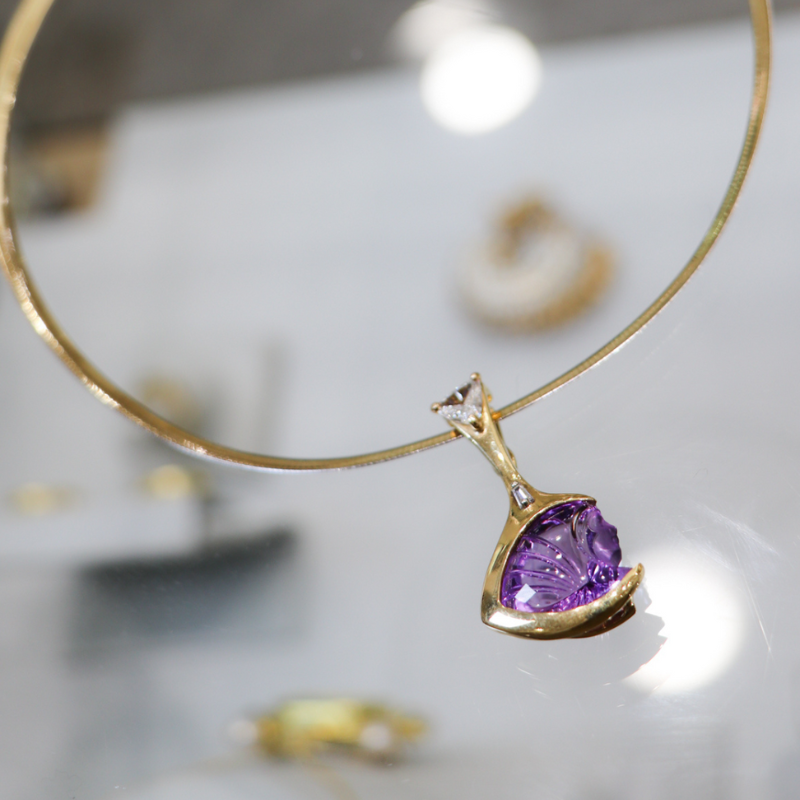
Few gemstones carry a backstory as vivid as amethyst. According to the GIA, the name derives from the Greek word amethystos, meaning a remedy against drunkenness. Early Greek mythology associated the gem with Bacchus, the god of wine, because of its rich wine-like color, and ancient Greeks and Romans genuinely believed the stone could keep its wearer clear-headed and quick-witted. The International Gem Society notes that the concept genuinely dates back to Ancient Greece, with some placing the stone directly in their mouth during festivities and others carving drinking vessels from it entirely.
The American Gem Society notes that amethyst jewelry has been dated as far back as 2000 BC, and that for many years it was held in the same regard as the diamond, reserved almost exclusively for royalty and the clergy. The Old Farmer’s Almanac adds that ancient Egyptians used amethysts in amulets as a form of prayer and protection from harm, and that the stone was believed to produce peaceful, healing dreams when placed beneath a pillow. It was counted among the twelve gemstones representing the twelve tribes of Israel and was said to have been worn by Saint Valentine himself, carved with an image of Cupid.
Amethyst in Antique and Heirloom Jewelry
It wasn’t until the discovery of large amethyst deposits in Brazil in the nineteenth century that the stone became more widely accessible. According to the Old Farmer’s Almanac, Russia was the major source of amethyst until that point, which kept it among the rarest and most coveted gemstones in the world. Before that shift, its rarity placed it firmly alongside diamonds, sapphires, and rubies in the category of the most precious stones. That change in availability coincided with some of the most celebrated periods in jewelry history, and amethyst featured prominently in all of them.
During the Victorian era, amethyst was a beloved choice for the sentimental, symbolism-rich jewelry of the period. Estate Diamond Jewelry notes that amethyst was among the most popular stones of the Victorian era, appearing alongside garnets, turquoise, sapphires, and pearls in pieces that ranged from humble to lavish. It appeared in mourning pieces, lockets, and elaborate brooches, often set in yellow gold with intricate detailing that reflected the romanticism of the age.
The Art Nouveau movement that followed, which ran roughly from the 1890s through 1914, embraced amethyst for its rich color and the way it complemented the organic, flowing designs of the era. According to Langa Antiques’ Antique Jewelry University, Art Nouveau produced some of the most distinctive and delightful jewels of any period, with fantastical female forms and nature-inspired motifs that made amethyst’s deep purple a natural and recurring choice.
The Art Deco period brought a different sensibility entirely. Geometric, architectural, and boldly modern, Art Deco designers used amethyst as a striking color accent against platinum and diamond settings. As Estate Diamond Jewelry notes, the Retro era that followed saw large colored gemstones like amethyst set in bold yellow and rose gold pieces that carried a distinctly Hollywood glamour, with oversized stones in elaborate settings that were designed to be seen.
 Amethyst in Modern Fine Jewelry
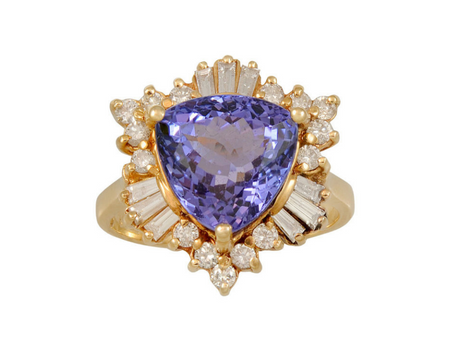
Amethyst has lost none of its appeal in the contemporary market. The American Gem Society notes that strong demand is emerging for rich, saturated gemstone tones, with bold cocktail rings and vibrant pendants leading the way in current fine jewelry trends. Amethyst sits squarely at the center of that movement, prized for its deep, regal purple and the way it translates beautifully across both minimalist and statement settings. Whether set in vintage-inspired yellow gold or sleek modern white gold, amethyst’s depth of color gives it a presence that reads as genuinely luxurious regardless of the setting.
Antique Jewelry Appraisal Washington DC: How to Choose, Appraise, and Care for Amethyst
The most important factor in evaluating amethyst is color. The GIA notes that the finest stones display a strong, pure purple with red and blue flashes, while very dark or very pale stones are considered less valuable.
At Charles Schwartz & Son, we have spent over a century evaluating and appraising fine and antique jewelry, and we approach every piece with the same care regardless of its origin or age. As one of the few antique jewelry stores DC residents have relied on since 1902, we are here to help you understand what you have and what it’s worth.
Key Takeaways: Amethyst in Antique and Fine Jewelry
- Amethyst has been one of the most prized gemstones in human history, worn by royalty, clergy, and collectors across every major civilization
- Its name comes from the ancient Greek word for a remedy against drunkenness, a connection to clarity and wisdom that has followed it through the centuries
- In the world of antique and heirloom jewelry, amethyst appears prominently across the Victorian, Art Nouveau, Art Deco, and Retro eras, each with its own distinctive style and character
- Amethyst is one of the most accessible fine gemstones on the market, available in striking sizes at a range of price points
Frequently Asked Questions
Is amethyst a precious or semiprecious stone?
Amethyst is classified as a semiprecious stone today, but that wasn’t always the case. For much of its history, it was considered one of the cardinal gemstones alongside diamonds, sapphires, rubies, and emeralds. According to the American Gem Society, it was only the discovery of large Brazilian deposits in the nineteenth century that made it widely accessible and shifted its classification.
How do I know if my amethyst jewelry is antique?
The best way to determine whether an amethyst piece is genuinely antique is to have it professionally evaluated. At Charles Schwartz & Son, our team looks at the construction of the setting, the cut of the stone, the metal used, and any hallmarks present. Pieces from the Victorian, Art Nouveau, and Art Deco eras each have distinct characteristics that our experienced team can identify.
Can amethyst fade over time?
Yes. The GIA notes that prolonged exposure to strong light can cause amethyst to fade, and that excessive heat can remove its color entirely. For this reason, amethyst jewelry should be stored away from direct sunlight and not exposed to heat treatments unless handled by a professional.
What is the most valuable shade of amethyst?
According to the GIA, the highest quality amethyst displays a strong, pure purple with reddish and bluish flashes. Very dark stones and very pale stones are considered less desirable. The finest grade, sometimes called deep Russian amethyst, is exceptionally rare.
Is amethyst a good choice for an engagement ring?
Amethyst is a lovely choice for those who want something personal and colorful rather than traditional. With a hardness of 7 on the Mohs scale, it is appropriate for daily wear, though it requires a bit more care than harder stones like sapphires or diamonds. We are happy to walk you through your options in person at our Washington DC or Chevy Chase locations.
A Century of Expertise, Right Here in Washington DC
At Charles Schwartz & Son, we have been handling fine and antique jewelry since 1902. Whether you have inherited a piece of heirloom jewelry, are curious about an antique jewelry appraisal, or are simply looking to learn more, our team is here to help.


